
A sophisticated heat exchanger solution saves energy in New York
The Bank of America Tower at One Bryant Park in Midtown Manhattan features some of the most sophisticated heating, ventilation and airconditioning equipment in the world.
DATE 2026-02-09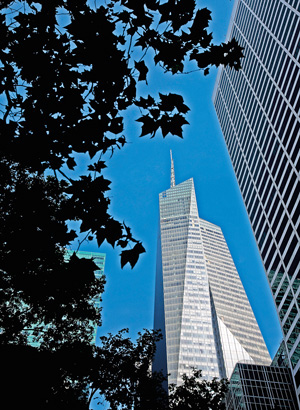 Bank of America Tower, USA
Among many sustainable features, the building includes energy efficient applications incorporating Alfa Laval heat exchangers that are used in free cooling, ice thermal storage and in a cogeneration system that includes an absorption chiller.
Free cooling – seasonal savings
Three stories below ground, several Alfa Laval plate heat exchangers are used in parallel with the building’s chillers to save energy.
During the five months of the year when ambient temperatures are low enough, outside air and a cooling tower are used to produce chilled water in the plate heat exchangers.
This reduces or eliminates the need for mechanical refrigeration and dramatically cuts the use of electricity to cool the building.
Cool chiller for ice storage
In the height of summer, One Bryant Park can save energy through the use of ice thermal storage in the basement.
“We have a chiller that is dedicated to ice making,” says Don Winston, Vice President of technical services at The Durst Organization, the building’s owner. “It’s part of a closed loop system where an ethylene glycol solution circulates through the chiller and a coil of plastic tubing in the ice storage tanks. The cold glycol solution produced in the chiller simply freezes the water surrounding the coils in the tank.”
All this happens at night when the cost of electricity to run the chiller is at its lowest. At 8 am, when the cost of electricity climbs, the cycle is reversed and the ice melts.
That is when the glycol solution is circulated between the ice tanks and two AQ10 Alfa Laval plate heat exchangers, which then essentially act as a chiller. The AQ10 heat exchangers have a rated design pressure of 28 Bar (400 psi) and operate at a differential pressure of 26 Bar (375 psi). The glycol is between -8 and -3 degrees Celsius (17.6 and 26.6 Fahrenheit) depending on the point in the ice making cycle.
Cogeneration for more savings
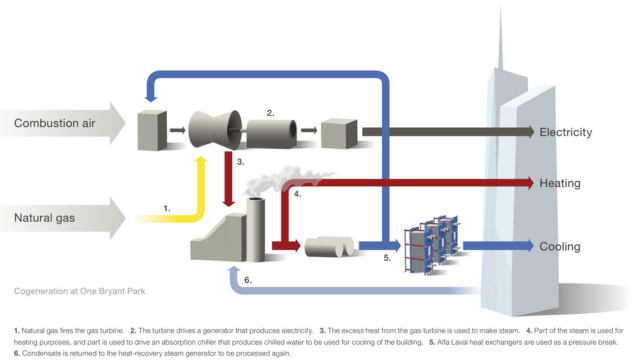
The building is also equipped with a cogeneration plant that uses more Alfa Laval heat exchangers to generate 75 percent of the building’s annual electrical needs. This is also called a CHP (combined heat and power) plant.
The exhaust gas from the turbine engine goes through a heat-recovery boiler and produces steam. This steam is then used to heat the building in the winter and to run a smaller absorption chiller during the summer.
High static pressure
The height of the tower generates an extremely high static pressure. Many of the heat exchangers are also used as pressure breakers to split the circuits into several smaller circuits with individual lower pressures. In this application, design pressures are up to 33 Bar (480 psi).
Energy conservation
The building uses 70 percent of the total energy contained in the natural gas it uses as fuel, compared to only 30 percent at a typical utility plant. All these efforts save money, reduce carbon dioxide emissions, and, from a leasing perspective, are compelling selling points. Tenants like law firms and banks appreciate environmentally friendly practices, and consequently lower energy costs.
Follow us on 

Facts and figures:
Products installed:
- 13 AQ10 Gasketed Plate Heat Exchangers
- 2 AQ8 Gasketed Plate Heat Exchangers
- 11 AQ6 Gasketed Plate Heat Exchangers
- 1 AQ4L Gasketed Plate Heat Exchangers
- 2 CB76 Copper Brazed Heat Exchangers
Design pressure is up to 33 bar (480 psi).
Benefits of an Alfa Laval plate heat exchanger
- High energy efficiency
- Flexible – configurable for broad range of applications
- Ensures optimal performance in specific applications base on specific needs
- Easy to install
- High serviceability